


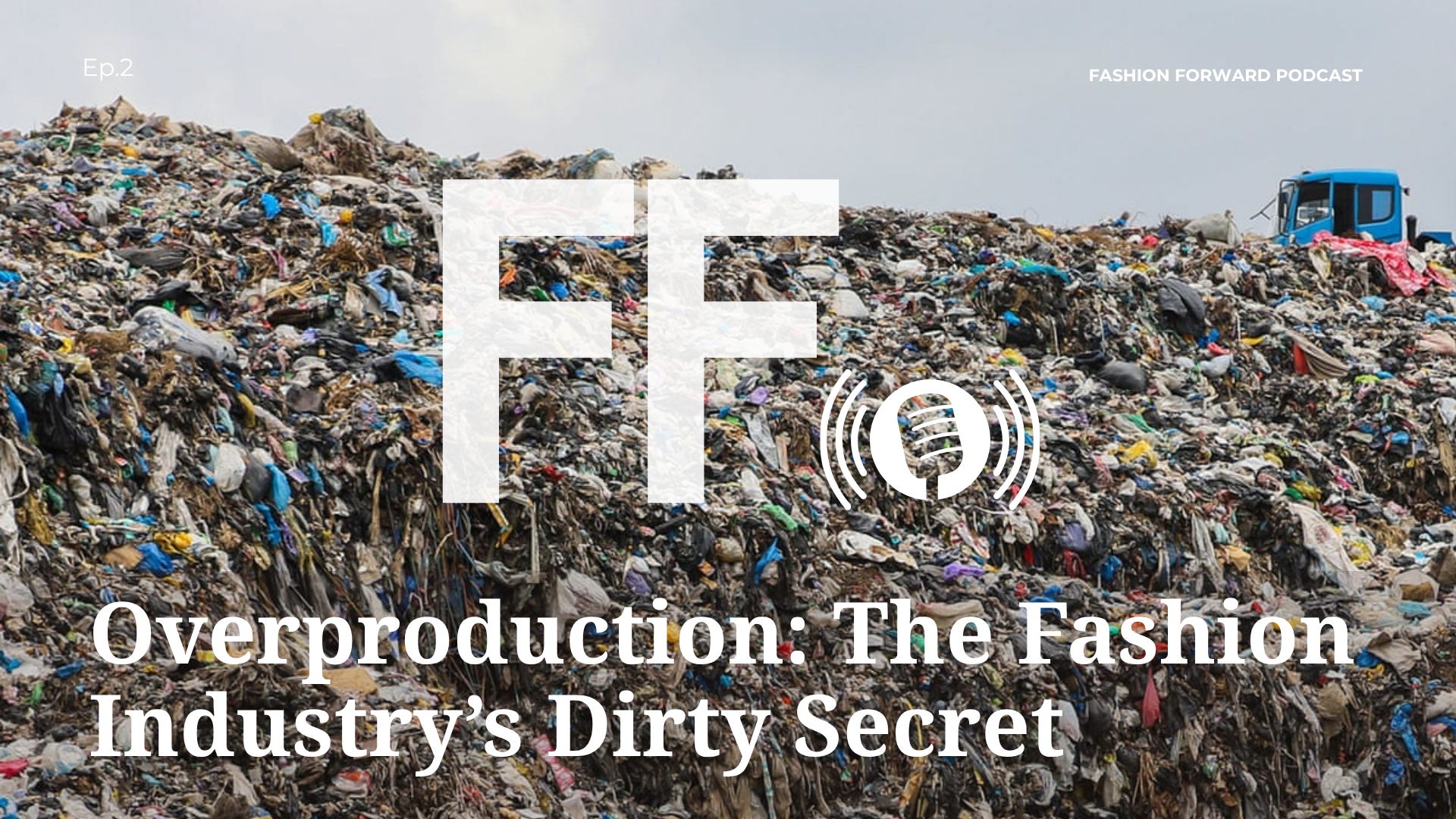
Welcome Back to Fashion Forward 👋
Hey friend,
If you’ve been around the fashion industry for any amount of time — whether as a founder, a product developer, a consultant, or even just a curious observer — you’ve probably sensed that something is fundamentally off about how clothes get made.
Not the design part. Not the creativity. That’s the part everyone loves.
I’m talking about what happens after the sketch. The production planning. The factory negotiations. The inventory decisions. The quiet, unglamorous back end of the business that most people don’t talk about — until now.
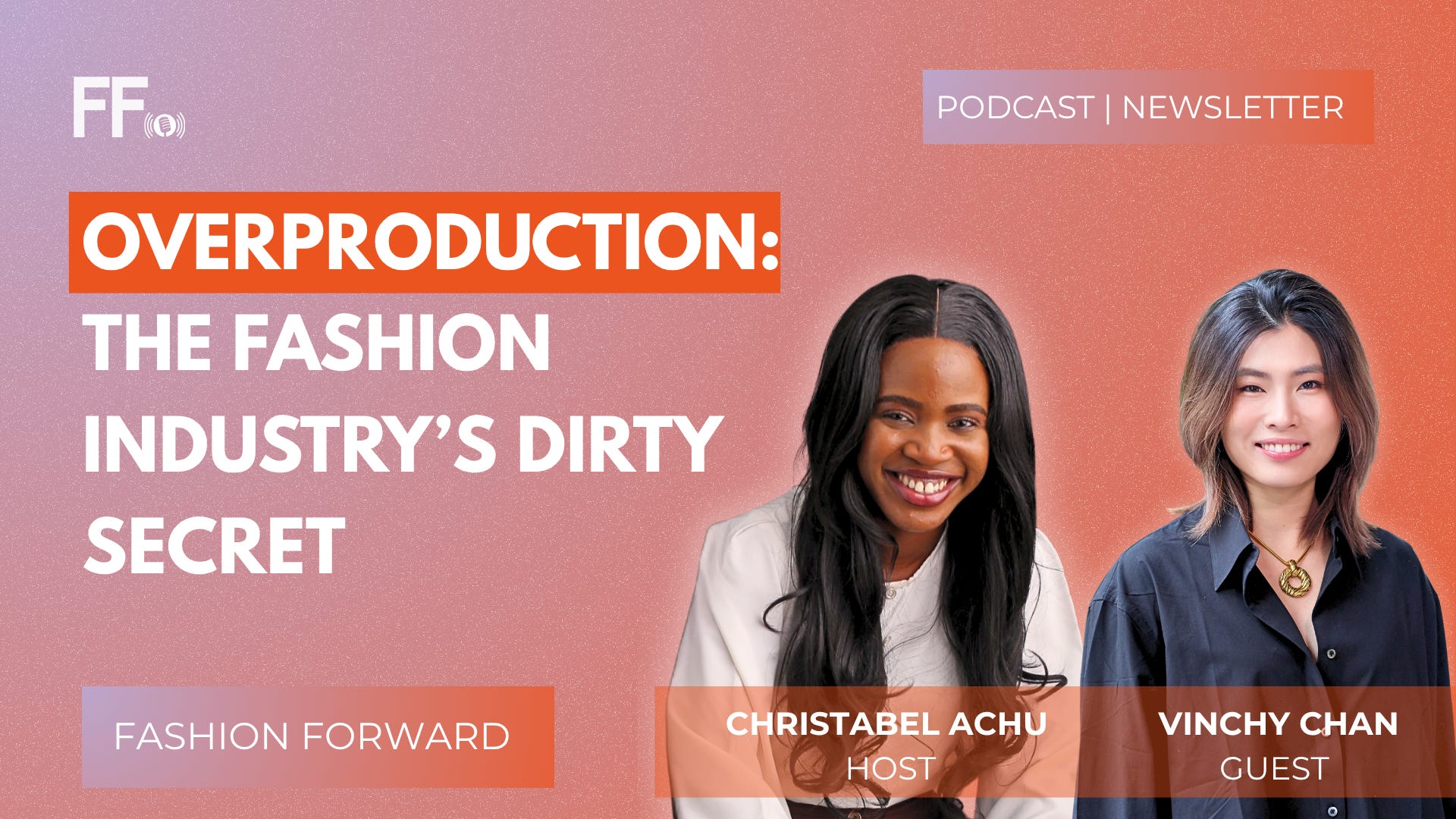
In Episode 2 of Fashion Forward, I sat down with Vinchy Chan Chan, founder of makea, a platform building the first infrastructure for agile, on-demand fashion production. And honestly? This conversation gave me so much. We went deep into overproduction — what it really is, why it’s still happening, and what it’s going to take to fix it at a structural level.
I took notes. I’m sharing them with you. Let’s get into it.
First, Who Is Vinchy Chan?
Vinchy Chan didn’t come into fashion through the traditional route. She’s a qualified accountant, former consultant, and — as she puts it — a “fashion outsider” who grew up dreaming of being a designer before her Tiger mom redirected her to study finance in the UK.

After burning out of consulting (relatable, honestly), she chased her childhood dream and launched Garment By — a made-to-order brand built around buying less and buying better. Through that experience, she learned fashion from the inside out. And what she found was not pretty.
The challenges of managing supply chain, navigating MOQs, accessing factories, and running production in any kind of agile way were so overwhelming that she eventually pivoted — not to build another fashion brand, but to build the infrastructure every fashion brand desperately needs.
That became makea.
She also mentioned something that really resonated with me: both of her co-founders are ex-civil engineers. As someone who also studied civil engineering before moving into fashion, I found that fascinating. There’s something about coming into this industry as an outsider that gives you a kind of clarity that insiders — people who’ve been doing it the same way for twenty years — simply don’t have anymore. You see the problems because you haven’t been conditioned to accept them as normal.
So... How Bad Is the Overproduction Problem Really?
Bad. So bad.
That was Vinchy’s answer. And she backed it up with a number that stopped me mid-sentence.
Even at top luxury fashion brands, around 50% of their best-selling products end up either discounted or sent to landfill. Not the slow movers. Not the risky experimental pieces. The hero products.
Let that sit for a second.
If that’s what’s happening with the bestsellers, what do you think is happening to everything else in the collection?
Vinchy broke it down further. A fashion collection typically has three tiers: the cash cow bestsellers, the add-on value pieces that increase basket size, and the eye-catching statement styles that communicate brand aesthetic but aren’t expected to be high sellers.
Here’s the part that blew my mind: many brands apply the same production quantities across all three tiers. So the statement piece they already know won’t sell in volume? Same thousand units as the bestseller. That’s not a demand problem. That’s a planning and systems failure from the very first decision made.
Overproduction Doesn’t Start on the Factory Floor
One of the most important things Vinchy and I landed on was this: overproduction isn’t a downstream problem. It starts much earlier. Here’s the full picture:
1. The Sampling Process Before a single finished garment is made for sale, brands go through rounds of prototyping and sampling. Vinchy shared that up to 50% of designs that go through the sampling process never make it to production. But physical samples are made for all of them. That’s waste baked in before a brand has even placed an order.
2. Planning & Merchandising Decisions The way collections are planned — equal quantities across unequal styles — is structurally wasteful. It’s not incompetence. It’s a model that was designed for a different era and hasn’t been updated.
3. The MOQ Trap Factories require minimum order quantities. Brands over-order to gain production access, secure their place in the queue, and meet the margin per unit their CFO has set. The overproduction is, in many cases, planned. Deliberate. Factored into the budget before a single garment is cut.
4. Demand Forecasting That Doesn’t Work Vinchy made a point I completely agree with: fashion is one of the hardest categories in the world to forecast demand for. Consumer behaviour is subjective, trends are volatile, and with TikTok and Gen Z in the mix, what was trending six months ago can be irrelevant by the time you’ve produced for it. You can’t forecast your way out of overproduction when demand shifts in seconds.
5. The Normalisation of Failure Here’s the part that genuinely concerns me the most: it becomes a mindset. Brands build their entire business model around the assumption that only 10–30% of their inventory will sell at full price. They don’t see it as a problem. They see it as the industry.
This is why I always say: systems first. Because once the failure becomes the plan, no tool in the world will fix it until you change the underlying thinking.
The Factory Side of the Problem
Here’s something most conversations about overproduction completely miss: it’s not just brands making poor decisions. The factories are part of the system too.
Vinchy explained the factory economic model clearly: low margin per piece × high volume = survival. Factories aren’t greedy. They’re operating a model that was built a century ago to sustain workers, cover operational costs, and keep the lights on. High volume is the only way that model works.
When small brands come in asking for small batches, here’s what factories actually see:
Fragmented, hard-to-aggregate demand — hundreds of small brands each wanting 50 pieces is much harder to manage than one brand wanting 5,000.
High coordination costs — managing 10 small accounts is significantly more labour-intensive than managing 1 enterprise account for the same total volume.
Higher QC risk — small and emerging brands often submit unclear specifications, vague tech packs, and ambiguous briefs. Factories price that risk in. And they use MOQ as a filter to screen out clients who aren’t “ready.”
So the high MOQ isn’t cruelty. It’s a consequence of a system that was never designed for small-batch, on-demand production. Knowing this doesn’t make it less frustrating — but it does change where you focus your energy when trying to fix it.
MOQ: The Hidden Barrier to Entry Nobody Talks About Enough
Let’s put some numbers on this.
If you want to launch a collection of 5 styles at 200 units per style — which is on the lower end of traditional MOQs — you’re looking at £10,000–£15,000 out the door before you’ve made a single sale. Before your website is live. Before you’ve run a single ad. Before you’ve even confirmed that anyone wants what you’re making.
Add product development costs, branding, content creation, and the operational cost of running everything as a solo founder, and you start to understand why so many promising fashion brands either never launch, over-leverage themselves trying to, or launch with too much inventory and not enough runway.
Vinchy’s work at Makea is bringing that minimum order quantity down to 50–150 units per style. That is a massive, meaningful drop. And when I first heard her say it on our introductory call, I genuinely didn’t believe it was possible. But it is — and the way they’re doing it is worth understanding.
How Makea Is Making Small Batch Viable
Makea isn’t just a factory directory. It’s an infrastructure play — and the thinking behind it is sophisticated.
Here’s the core model:
Aggregating SME demand. Instead of one brand placing 50 units with a factory, Makea aggregates orders from multiple small brands to create a volume that’s attractive to the factory. The brand gets a small MOQ. The factory gets enough combined volume to make it worth their while.
Standardising the workflow. Factories on the Makea platform only need to learn one standardised production process — instead of adapting to a different system for every brand they work with. That removes a major coordination cost.
Embedding manufacturing know-how. This is the one I find most exciting from a systems perspective. Makea is codifying the kind of operational knowledge that currently lives in the heads of experienced production managers — and making it accessible to every brand using the platform, regardless of their background or expertise. Think of it as an AI production manager, what they call PILOT, available to every brand that would otherwise be flying blind.
Capturing structured data automatically. No separate data entry. Whatever happens through the platform — every order, every communication, every QC checkpoint — is captured and structured in real time. That data feeds a flywheel: the more brands use the platform, the smarter it gets at identifying and correcting inefficiencies.
The vision Vinchy describes is essentially a shared economy for manufacturing — like Uber, but for production capacity. And the long-term goal is to bring unit costs down by up to 30% compared to current small-batch pricing, making agile production not just possible but genuinely competitive with bulk production models.
The China Supply Chain Shift You Probably Haven’t Heard About
This part of our conversation was genuinely eye-opening — and I think it’s one of the most important pieces of context for anyone thinking about fashion production right now.
Vinchy, as a native Chinese founder with deep connections in Chinese manufacturing, has a front-row seat to something major: Chinese factories are restructuring.
High-volume orders are moving to cheaper labour markets in Southeast Asia. US tariffs and trade tensions are creating pressure from above. And the Chinese government is pushing hard on Industry 4.0 — investing heavily in robotics and advanced manufacturing technology.
The result? Factories that were built for volume are being forced to innovate. And some of them are experimenting with small-batch production in really interesting ways:
Some are doubling down on machines — automating enough of the production process to bring MOQs all the way down to a single piece. High cost, ultimate agility.
Others are opening dedicated small-batch lines within larger factories — handpicking skilled, adaptable labour who can switch between styles quickly.
Some are converting their product development departments from cost centres into small-batch production units — leveraging the high-skill, design-literate teams already in place.
And some former large-factory workers and managers, displaced by the decline of volume orders, are setting up independent workshops specialising in complex, high-quality, small-run production.
This structural shift is the trend that Makea is riding. And it’s happening right now.
The Tech Question: Enabler, Not Hero
I want to spend a moment on something I feel strongly about, because it came up in our conversation and I think it gets misunderstood constantly.
Everyone is talking about AI and technology fixing fashion. And technology can play a meaningful role — in demand forecasting, in coordination efficiency, in supply chain visibility, in embedding manufacturing know-how at scale. All of that is real.
But technology is an enabler. It amplifies what’s already there. Which means if the underlying system is broken — if data lives in people’s heads rather than structured processes, if tech packs are unclear, if planning decisions are made without visibility — then technology doesn’t fix anything. It just makes the chaos move faster.
This is the core of how I think about my consulting work. Systems first. Strategy second. Technology last.
Vinchy’s approach at Makea reflects exactly this. Rather than arriving at factories and demanding they adopt a new ERP system, they plug into existing behaviour — like WeChat, which most Chinese factories already use for coordination — and structure the data in the background. They build trust first, demonstrate value, and then gradually introduce more sophisticated processes. That’s not just good product design. That’s good change management.
The fashion industry is roughly 80% human labour — compared to something like electronics manufacturing, which is closer to 80% machine. Standardisation and automation are inherently harder in an industry built on human hands and creative decisions. You can’t just import a tech solution from another sector and expect it to stick. You have to understand the human system first.
What the EU Regulation Means (And What It Doesn’t Fix)
The EU is moving to make overproduction a legal, financial, and operational liability for fashion brands. Brands will face restrictions on destroying or discarding unsold inventory. Digital product passports are coming. Transparency requirements are tightening.
This is significant. Regulation is one of the most powerful drivers of behaviour change in any industry — when compliance means survival, people find a way to comply.
But here’s my honest take, and it’s one Vinchy agreed with: regulation addresses the symptom, not the cause. It will force brands to not destroy unsold inventory. It won’t automatically fix the planning and production systems that create unsold inventory in the first place.
The brands that will navigate this best are the ones that move now — before regulation forces their hand. Because those brands will spend the next two to three years building the production models, the supply chain visibility, and the inventory discipline that others will be scrambling to implement at the last minute. And in a competitive industry, that head start is worth a lot.
For SMEs especially, this is urgent. Enterprise brands have the capital to pivot when regulation hits. Smaller brands often don’t. The awareness gap is real, and it’s one of the reasons Vinchy is so focused on the SME segment.
Agile Production in Practice: What Changes?
Let’s make this concrete.
Traditional Production Agile Production MOQ 500–1,000 units per style 50–150 units per style Go-to-market time 6–12 months 8–10 weeks (first order) Repeat order time Several months 4–6 weeks Capital locked in inventory Very high Significantly lower Demand validation Forecast-based guesswork Test → learn → restock Financial risk Very high Substantially reduced
The unit cost per piece is still higher in small-batch production — roughly 20–50% more than bulk, depending on design complexity. But that comparison misses the more important number: how much capital you’re locking up.
Producing 50 units versus 1,000 units across a capsule collection frees up enormous amounts of cash — cash that can go into marketing, go-to-market strategy, or simply give a founder the breathing room to make better decisions. In an industry where external capital is famously hard to raise, that financial flexibility isn’t a nice-to-have. It’s survival.
Three Things Vinchy Told Emerging Brands to Do Right Now
She ended our conversation with practical advice, and I thought it was worth preserving exactly as she gave it:
1. Don’t over-spec it. Don’t wait for the perfect product. Don’t let perfectionism slow you down. The best evidence you can gather is real market feedback — and you can only get that by launching. Get to market fast, in small batches, and let customers tell you what works. An imperfect product in market teaches you infinitely more than a perfect product still in development.
2. Take action — every single day. Ideas without action are just noise. One concrete step per day toward launch. Don’t let overwhelm become paralysis. Movement creates momentum.
3. Hustle creatively and use the tools available. There are more AI tools, affordable platforms, and accessible infrastructure available to fashion founders today than at any point in history. Be resourceful. Be creative with how you spend. And don’t be afraid to hustle your way into rooms and opportunities — Vinchy joked that she’s never paid for a trade show stand in her life.
My Takeaway From This Conversation
What struck me most about Vinchy — beyond the intelligence of what she’s building — is her why.
She didn’t find a market opportunity and build a product around it. She found a problem she genuinely cared about — the same problem I’ve watched play out over and over in this industry — and built her life around solving it.
That’s the difference between a company that lasts and one that doesn’t. Because changing a legacy industry is slow. It’s hard. It’s full of resistance from people who’ve done it the same way for decades. You need something more than a business case to keep going through that.
For Vinchy, it’s creativity. The belief that no creative idea should go to waste because a founder couldn’t access the right production infrastructure. That every designer — regardless of their budget, their background, or their network — should be able to bring their vision to life without being crushed by a system that was built for a different era.
That’s a mission worth building for.
And it’s exactly the kind of work that Fashion Forward exists to amplify.
You can connect with Vinchy Chan or visit makea’s website.
Listen to the Full Episode
If this resonated with you, the full conversation is available on YouTube, Spotify and Apple Podcasts. Stream here.
We go even deeper on the China supply chain shift, the EU regulation timeline, and what the ideal fashion supply chain looks like in the next 5–10 years.
And if you’re a fashion brand founder navigating production challenges, overproduction pressure, or the overwhelm of figuring out where technology actually fits into your workflow — I’d love to connect. This is exactly the work I do every day, visit my website.
Until next time,
Christabel Achu Fashion Technology Consultant | Systems + Technology = Reduced Risk, Cost & Delays
Follow Fashion Forward for conversations at the intersection of fashion, technology, and the systems that either hold the industry back — or move it forward.
Thanks for making this great episode!